In-house project · Web studio
Íslandsvefir: rebuilding our own website
A website that sells web development is a sample of the work. Ours was half-finished and no longer told the truth about what we do. We rebuilt it from scratch and made the quality requirements part of the build itself.
- Published
- Updated
- Length
- 9 min read
In short
- The old site was a WordPress and Elementor build with lorem ipsum, counters stuck at zero and no descriptions for search engines.
- On the mobile home page, Lighthouse performance went from 79 to 100, LCP from 4.7 to 1.4 seconds and page weight from 1.58 MB to 104 KB, with no JavaScript.
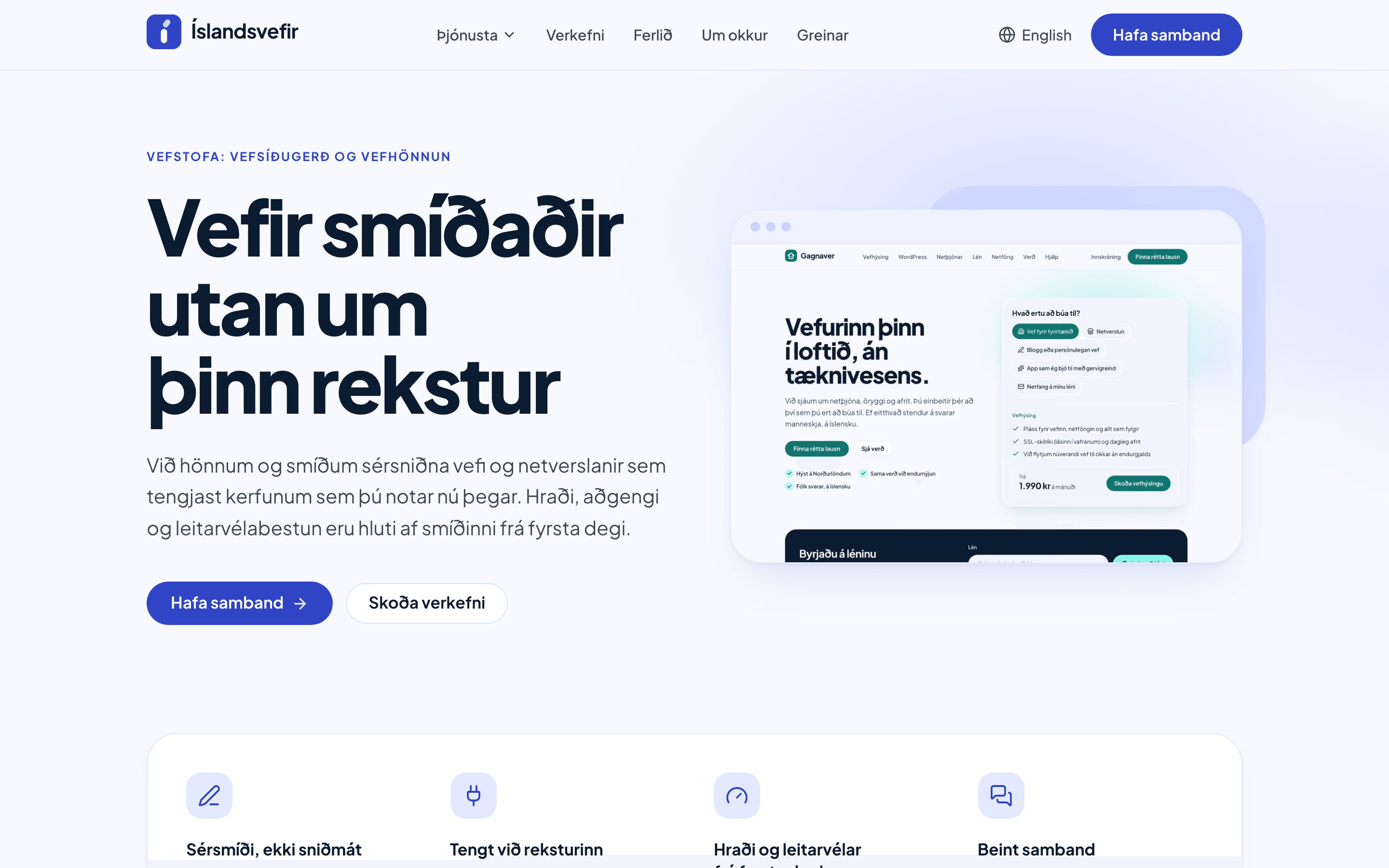
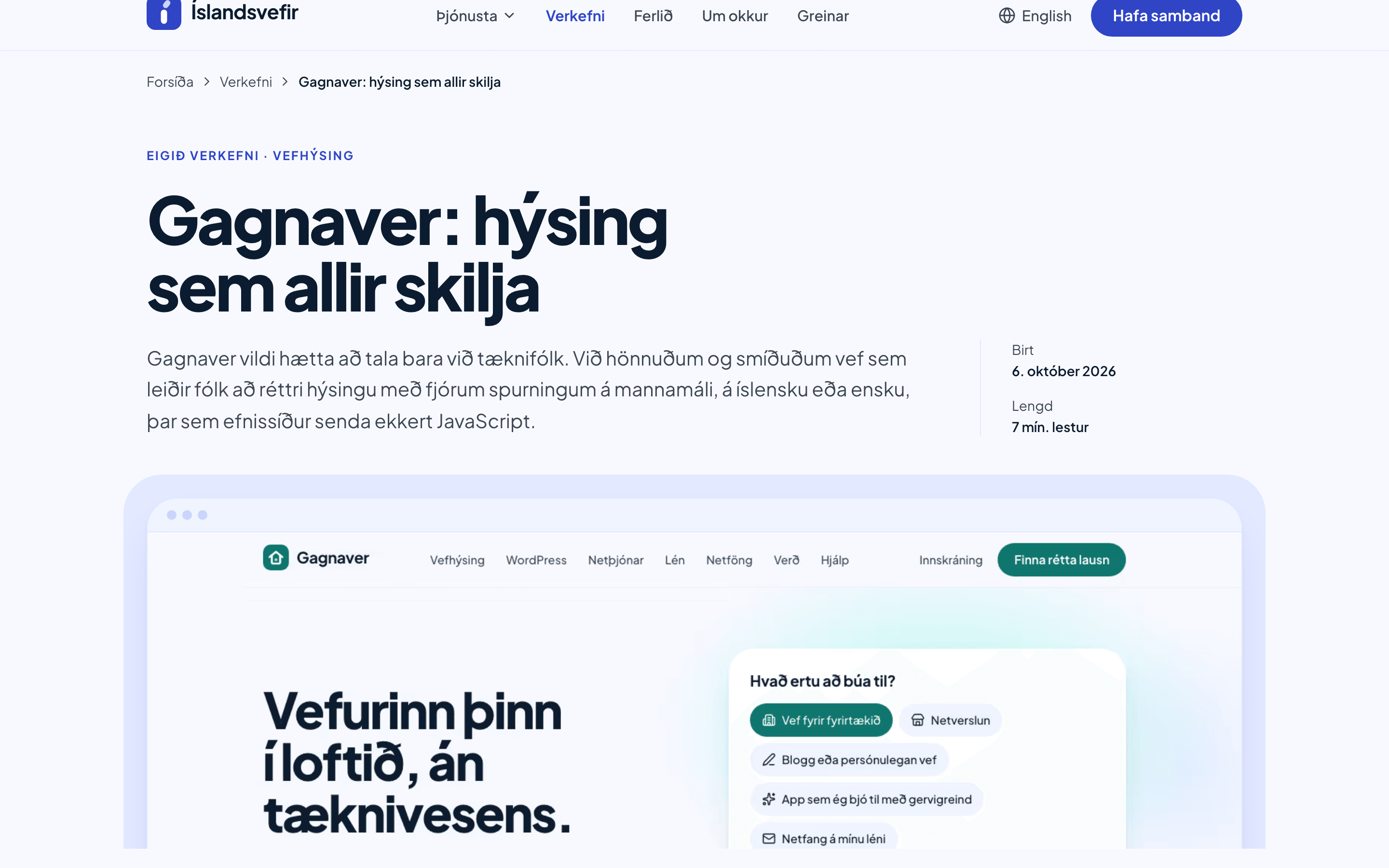
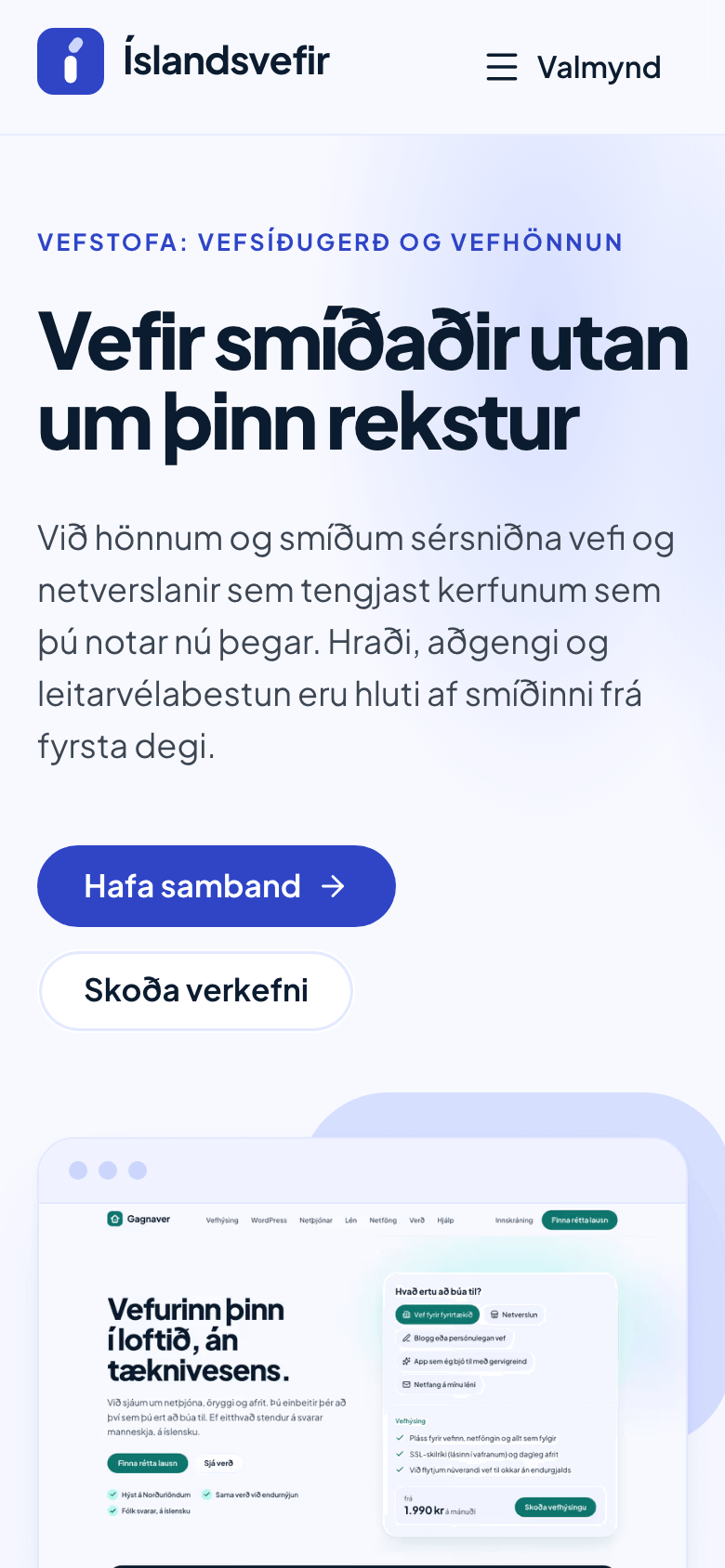
- The new site is static and bilingual, and is built on the same design system as the Gagnaver site.
- The build or the tests fail if a page is missing a description, has more than one H1, a broken link or an accessibility error.
- The new numbers were measured on the live islandsvefir.is after launch, on 22 October 2026.
Fact sheet
- Client
- Íslandsvefir
- Sector
- Web studio
- Year
- 2026
- Services
- Tech
- Astro
- TypeScript
- Tailwind CSS 4
- MDX
- Playwright
- axe-core
- Lighthouse CI
- Satori
01. Background
Íslandsvefir has built websites for Icelandic businesses and offered websites on a subscription. The subscription plans Loki, Þór and Óðinn, which the old site promoted, are still offered, and their prices are now published on the website subscription page. Íslandsvefir is a brand of Gagnaver Datacenter AB, the same company that runs the web host Gagnaver.
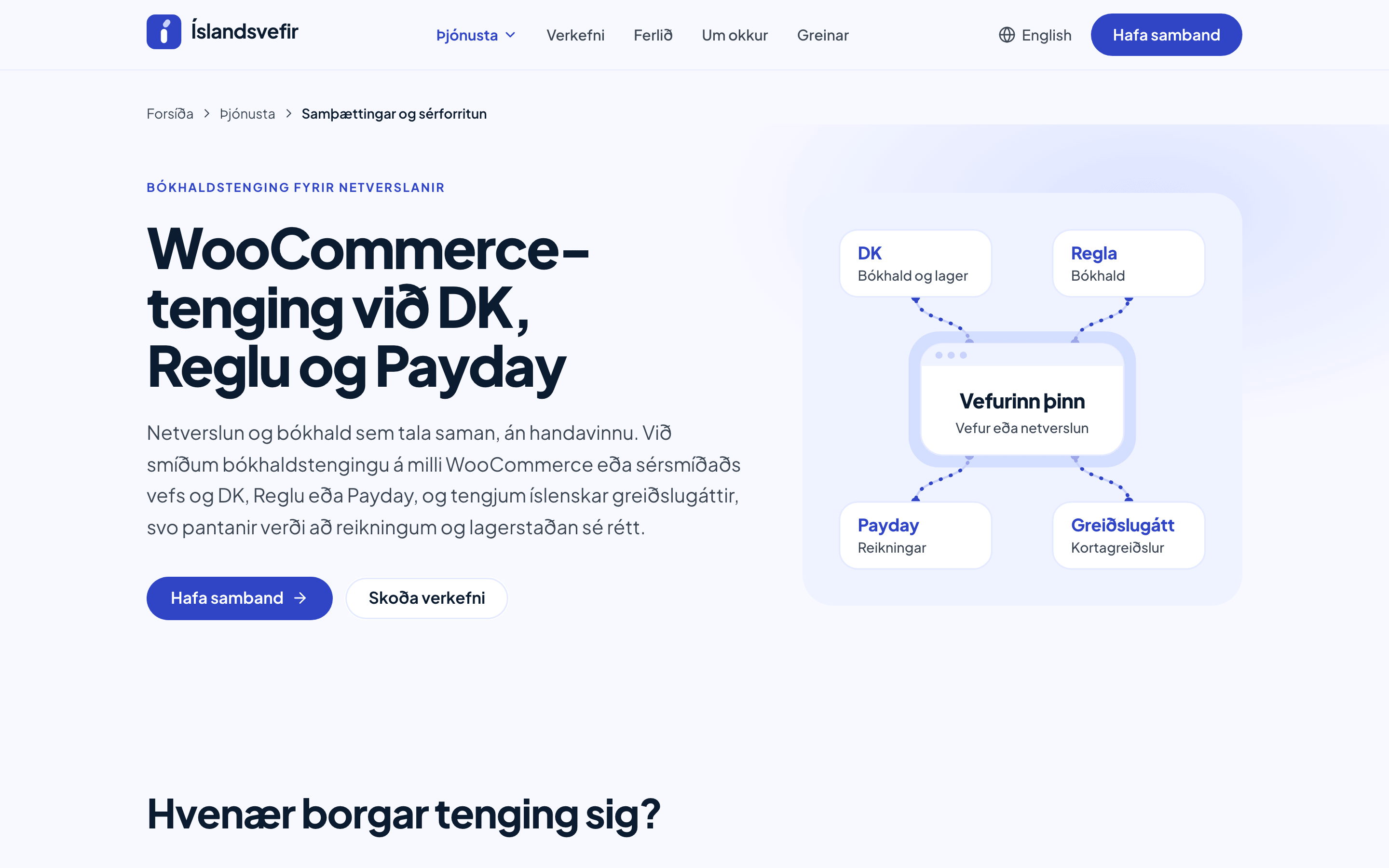
The focus is changing. Íslandsvefir is becoming a studio that designs and builds bespoke websites and online stores and connects them to the systems a business already runs, such as DK, Regla and Payday. SEO and digital marketing are part of the core. The website subscription stays, but as the simpler option rather than the main product.
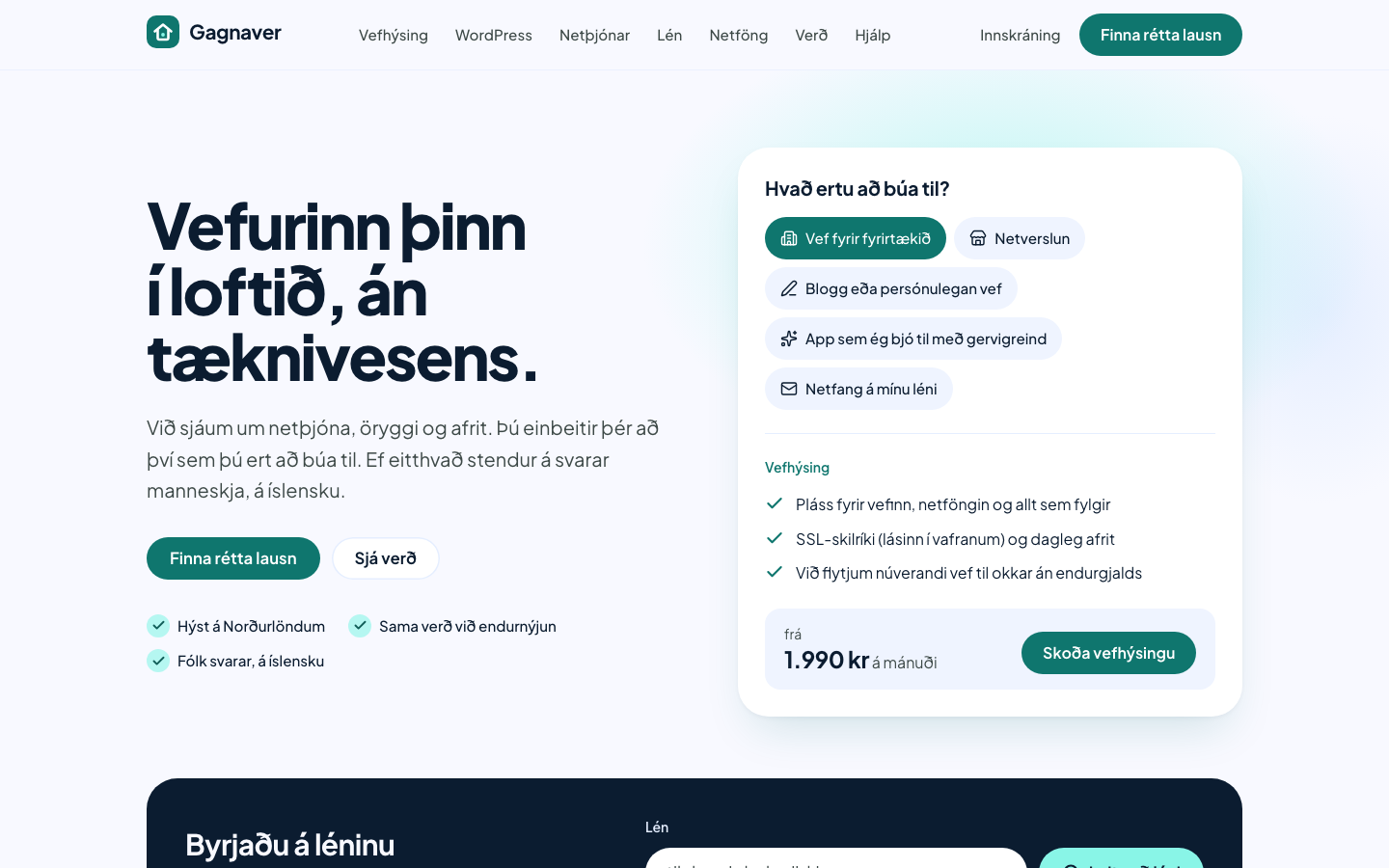
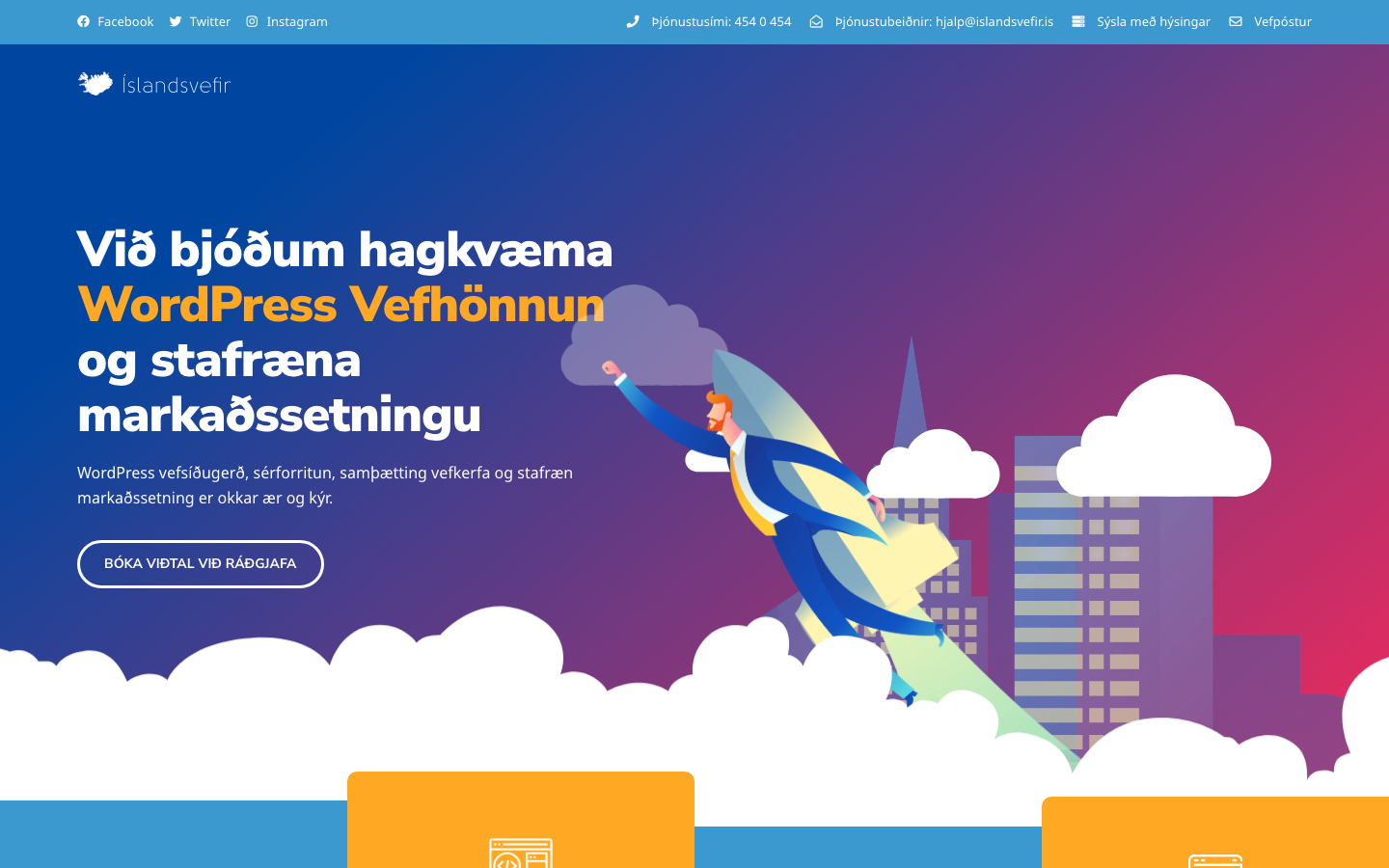
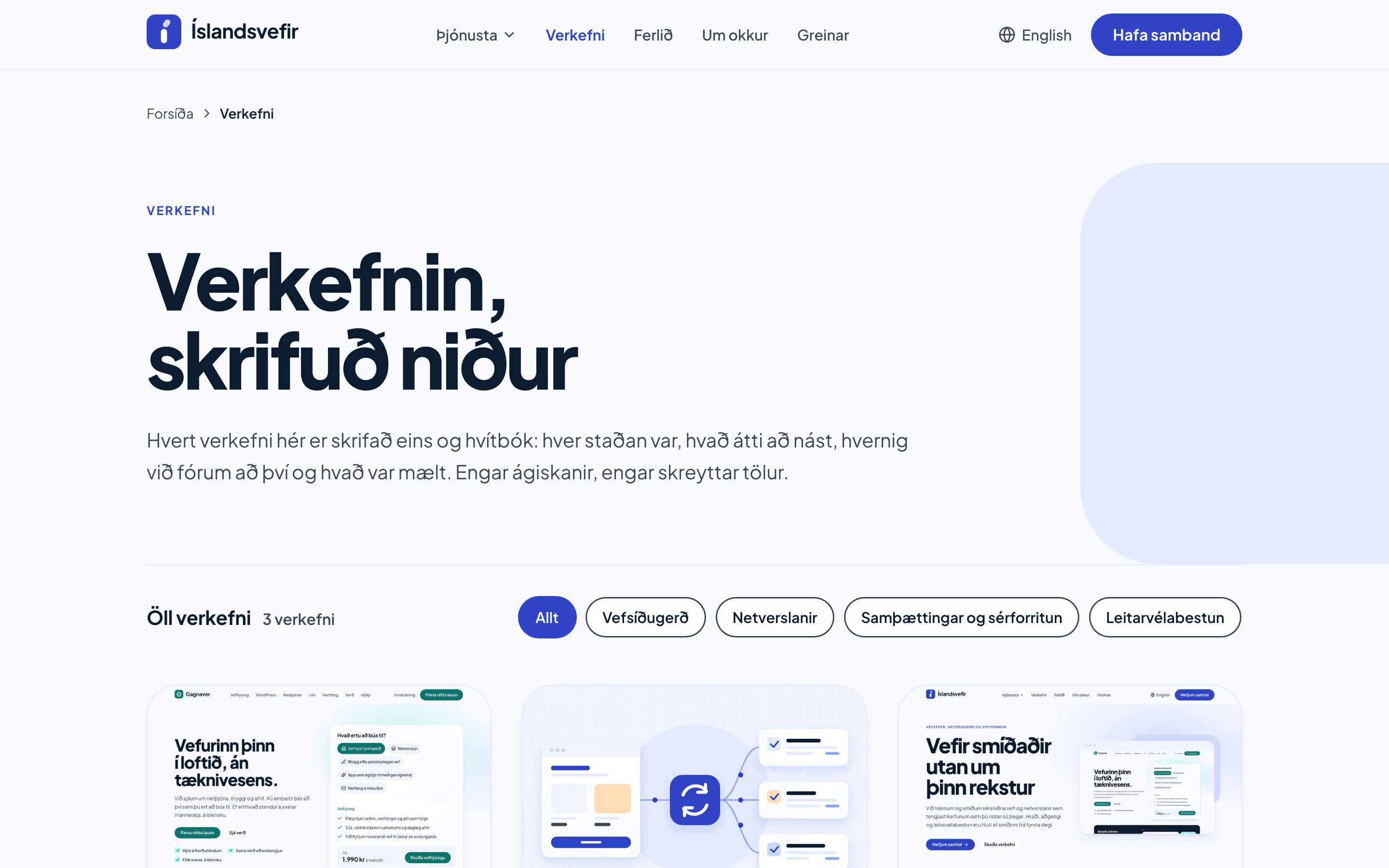
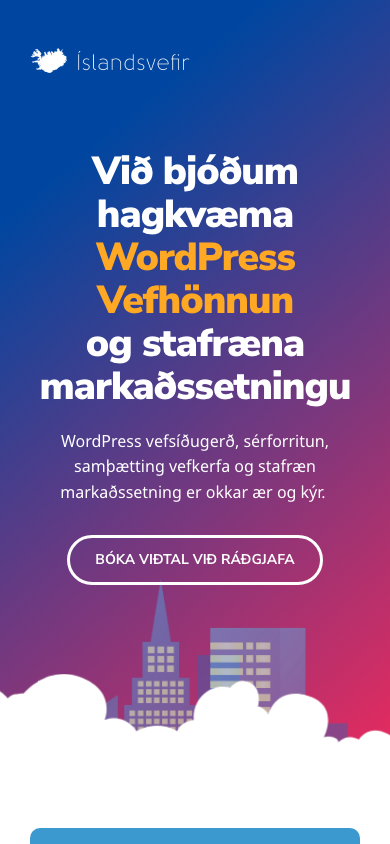
The old site told a different story. It was built in WordPress with Elementor and was half-finished: two real pages, lorem ipsum, menu links that led nowhere, counters stuck at zero and no work to show.
02. The challenge
A web studio is judged by its own website. If it is slow, inaccessible or untrue, it hardly matters what it says. So the challenge had two parts.
Telling the truth. The new site could not claim anything we cannot back up. That means no invented numbers, no testimonials without consent, no client logos without permission and no counters. The work had to be real and the results measured.
Being the proof. We tell clients that performance, accessibility and SEO belong in the build, not on top of it. Our own site has to meet that standard, and not only on launch day but with every change.
We measured the old site before starting, so the comparison would be honest.
03. Goals
The goals come from the design document, which was written before a line of code. Here they are given IDs so the baseline in section 6 can point back to them.
- G1The site says plainly what we do: bespoke websites, online stores and integrations, with a website subscription as the simpler option.
- G2Case studies are written as white papers, with a source and a date for every number.
- G3Lighthouse performance ≥ 95 on mobile, LCP under 2.0 seconds and no layout shift.
- G4A description, Open Graph, JSON-LD and exactly one H1 on every page, verified automatically at build time.
- G5WCAG 2.2 AA: 100 for accessibility in Lighthouse and zero axe violations on any page.
- G6Icelandic and English with localised URLs and reciprocal hreflang links.
04. Approach
Research first. Before any design work we looked at search terms and competitors: which words people use when they look for web design, online stores and accounting integrations, and how other Icelandic studios present their work. In our review, most competitors’ case studies were images and a few lines of text, and few covered DK, Regla and Payday integrations in depth. That was the opening.
Same system, own voice. Rather than starting from nothing, we built on the design system we made for Gagnaver: the same typeface, spacing, shapes and tested contrast rules. Íslandsvefir gets its own primary colour, a fjord blue, and a more editorial look, with larger headings and more asymmetric layouts.
Requirements as code. We wrote the quality requirements as automated tests before the pages were built. A page that fails them does not ship.
05. The solution
A static site
The site is built with Astro and published as finished HTML pages. There is no database to patch and no CMS to defend. Most pages ship no JavaScript at all. Menus use built-in HTML features and the work filter is plain CSS. The only script on a case study is the button that prints the page or saves it as a PDF.
Quality checks that fail the build
After every build, an automated validator reads every single page. If it finds an error, the build fails and nothing goes live.
| Check | Requirement |
|---|---|
| Title and description | Present, the right length and unique across pages |
| Headings | Exactly one H1 and no skipped levels |
| URLs | Canonical URL, reciprocal hreflang links and no broken internal links |
| Sharing | An Open Graph image that exists and the correct URL |
| Structured data | Valid JSON-LD and breadcrumbs that match the visible trail |
| Images | Alt text on every image that is not purely decorative |
| Sitemap | Lists exactly the pages that should be found |
On top of that, browser tests visit every page in the sitemap, on desktop and on a 390-pixel-wide screen. They require zero axe accessibility violations, no browser errors and no horizontal scrolling. Lighthouse CI requires at least 95 for performance and 100 for accessibility, best practices and SEO.
Search engines and AI
Every page gets its own @graph of structured data: organisation, website, page, breadcrumbs and, where relevant, a service, an article or FAQs. The sitemap is hand-built with hreflang pairs, Open Graph images are generated for every page at build time, and llms.txt describes the company for language models. We mapped the old URLs and decided where each should 301-redirect, so the old site’s rankings carry over as far as possible.
Case studies as white papers
The case studies, this one included, follow one template: a fact sheet, a short summary, numbered sections, goals with IDs and results that point at the goal they answer, with a source and a date. The template refuses to show a quote unless consent is recorded.
06. Results
The baseline was measured on 6 October 2026 against the live old site: a single run of Lighthouse 12.8.2 in mobile mode and an inspection of the rendered home-page HTML. The new site was measured on the live islandsvefir.is on 22 October 2026, after launch, with Lighthouse 12.6.1, also in mobile mode, and we report the median of three runs. The methods are close but not identical: a different Lighthouse version, and one run against the median of three.
Before launch we measured the new site on a local production build. The measurement on the live domain, with the real server, TLS and compression, gave the same result: 100 in all four categories, an LCP of 1.4 seconds and 104 KB.
Baseline for G3
Lighthouse performance ≥ 95 on mobile, LCP under 2.0 seconds and no layout shift.
- Lighthouse performance, home page, mobile (old site)79 / 100Source: Lighthouse 12.8.2, mobile, live islandsvefir.isMeasured
- Largest Contentful Paint, home page (old site)4.7 sSource: Lighthouse 12.8.2, mobile, live islandsvefir.isMeasured
- Home page weight and requests (old site)1.58 MB · 84Source: Lighthouse 12.8.2 network requestsMeasured
- JavaScript transferred on the home page (old site)634 KBSource: Lighthouse 12.8.2 network requests (2.72 MB uncompressed)Measured
Answers goal G3
Lighthouse performance ≥ 95 on mobile, LCP under 2.0 seconds and no layout shift.
- Lighthouse performance, home page, mobile (new site)100 / 100Source: live islandsvefir.is, Lighthouse 12.6.1, mobile, median of 3 runsMeasured
- Largest Contentful Paint, home page (new site)1.4 sSource: live islandsvefir.is, Lighthouse 12.6.1, mobile, median of 3 runsMeasured
- Home page weight and requests (new site)104 KB · 9Source: live islandsvefir.is, Lighthouse 12.6.1, mobile, median of 3 runsMeasured
- JavaScript transferred on the home page (new site)0 KBSource: live islandsvefir.is, Lighthouse 12.6.1, mobile, median of 3 runsMeasured
Baseline for G4
A description, Open Graph, JSON-LD and exactly one H1 on every page, verified automatically at build time.
- Lighthouse SEO, home page, mobile (old site)92 / 100Source: Lighthouse 12.8.2, mobile, live islandsvefir.isMeasured
- Description · Open Graph · JSON-LD on the home page (old site)None · 0 · 0Source: Playwright, rendered home-page DOM; confirmed with curl on /leitarvelabestun-seo/Measured
- H1 headings on the home page (old site)6Source: Playwright, rendered home-page DOMMeasured
Answers goal G4
A description, Open Graph, JSON-LD and exactly one H1 on every page, verified automatically at build time.
- Lighthouse SEO, home page, mobile (new site)100 / 100Source: live islandsvefir.is, Lighthouse 12.6.1, mobile, median of 3 runsMeasured
- Description · Open Graph · JSON-LD on the home page (new site)Yes · 12 · 1 graphSource: Built home-page HTML; the SEO validator requires all three on every pageMeasured
- H1 headings per page (new site)1Source: SEO validator: exactly one H1 on all 47 pagesMeasured
Baseline for G5
WCAG 2.2 AA: 100 for accessibility in Lighthouse and zero axe violations on any page.
- Lighthouse accessibility, home page, mobile (old site)95 / 100Source: Lighthouse 12.8.2, mobile, live islandsvefir.isMeasured
- Home-page images with empty alt text (old site)21 of 21Source: Playwright, rendered home-page DOMMeasured
Answers goal G5
WCAG 2.2 AA: 100 for accessibility in Lighthouse and zero axe violations on any page.
- Lighthouse accessibility, home page, mobile (new site)100 / 100Source: live islandsvefir.is, Lighthouse 12.6.1, mobile, median of 3 runsMeasured
- Home-page images with empty alt text (new site)2 of 3Source: Built home-page HTML; both are decorative and hidden from screen readers (aria-hidden)Measured
- axe accessibility violations, all pages (new site)0Source: Playwright and axe-core 4.13, 38 URLs at two screen widths plus the 404 pageMeasured
Baseline for G6
Icelandic and English with localised URLs and reciprocal hreflang links.
- hreflang links on the home page (old site)0Source: Playwright, rendered home-page DOMMeasured
Answers goal G6
Icelandic and English with localised URLs and reciprocal hreflang links.
- hreflang links on the home page (new site)3Source: Built home-page HTML: is, en and x-defaultMeasured
- Sitemap pages per language (new site)19 + 19Source: dist/sitemap.xml, every page paired with hreflangMeasured
The old site downloaded 634 KB of JavaScript to show mostly static content, and the largest element on the home page did not appear until 4.7 seconds on mobile. The new home page downloads no JavaScript, weighs 104 KB across 9 requests and shows its largest element after 1.4 seconds. Nothing on the page shifts while it loads.
For search engines the basics were missing: no description, no structured data and six H1 headings. Now every page has a description, Open Graph tags, structured data and one H1, and the build fails if any of them is missing. In the browser tests, axe found no accessibility violations on any page, on desktop or at 390 pixels wide.
The goals for performance, search, accessibility and two languages are met in these measurements. The goals for clear positioning and white-paper case studies are not measured with numbers. They show on the site itself, this page included.
07. Lessons and next steps
Tested quality stays. It is easy to get a good score once. It is harder to keep it as content grows. That is why the requirements are part of the build and not a checklist someone has to remember.
Honesty is a design decision. It was tempting to fill the site with counters and logos. Instead we publish less, but everything on the site can be checked.
Systems pay off. Building on the Gagnaver design system meant the time went into content and structure, not into redesigning buttons.
The next step is to make sure the site keeps meeting its goals as content grows, and to measure it regularly in the same way. More case studies will follow as clients agree to publication.